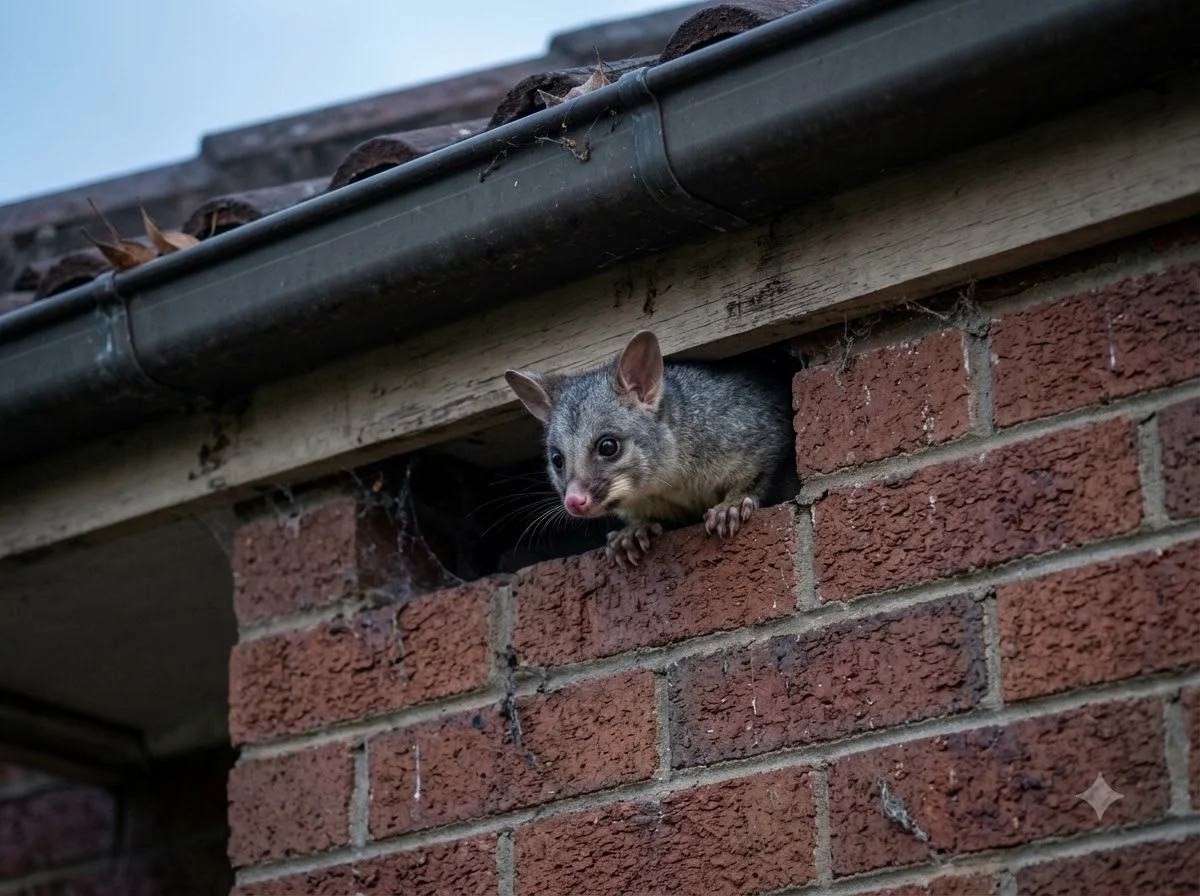
Updated 20 November 2026 · PestFree Nests, Clayton South
Thumping, scratching and running across the ceiling at night is one of the most common calls we get across south-east Melbourne. Most of the time it’s a possum that has found a gap into the roof. This guide explains how to tell it’s a possum, what Victorian law allows, the mistakes to avoid, and how to stop it coming back.
Quick answer
- Possums are protected native animals in Victoria. You can’t harm them, and you can’t take them away and release them somewhere else.
- A brushtail possum in your roof can be trapped in a cage trap that doesn’t injure it, then released on the same property, within 50 metres, after sunset on the day it was caught.
- Trapping alone doesn’t fix it. Unless the entry gap is sealed, the same possum (or the next one) moves straight back in.
- The lasting fix is: find every entry point, get the possum out, seal the gaps, and give it somewhere else to live, such as a possum box in a nearby tree.
Is it a possum, a rat or a bird?
| Possum | Rats or mice | Birds | |
|---|---|---|---|
| When | Mostly after dusk and before dawn | Night, often all night | Early morning and daytime |
| Sound | Heavy thumping, like footsteps; hissing or grunting | Light scratching and scurrying, gnawing | Fluttering, chirping, pecking |
| Signs | Large droppings, strong urine smell, stains on the ceiling | Small droppings, chewed cables or food packets | Nesting material near eaves or gutters |
| Entry | Broken tiles, gaps under eaves, gaps where trees touch the roof | Small gaps the size of a 20c coin | Gaps under roof tiles and solar panels |
If you hear heavy steps around dusk and then again before sunrise, it’s almost certainly a possum heading out to feed and coming home.
What Victorian law says
Possums are protected under the Wildlife Act 1975. The rules for possums living in a roof or other building are strict, and the penalties are real:
- A common brushtail possum in a roof or building may only be caught in a cage trap designed not to injure it.
- It must be released on the same property, no more than 50 metres from where it was caught, after sunset on the day of capture.
- Relocating a possum further away is illegal, and it’s also cruel: a possum dropped in a strange area is likely to die from stress, cars, dogs or fights with the possums already living there.
- If it isn’t possible to release the possum on your property, it must be humanely put down by a registered vet within 24 hours, at the trapper’s cost.
- Ringtail possums have stricter rules than brushtails. If you’re not sure which one you have, ask us before doing anything.
For the official wording, see the Victorian Government’s guidance on managing possums.
Mistakes that make it worse
- Sealing the gap while the possum is inside. A trapped possum will chew, scratch and damage the ceiling trying to get out, and may die in the roof, which causes a terrible smell.
- Trapping without sealing. The possum is released within 50 metres, as the law requires, and walks straight back in the same night.
- Leaving a trap set in the heat of the day. A possum left in a cage in direct sun can overheat. Traps should be set at dusk and checked first thing in the morning.
- Poisons, sprays and “deterrent” gadgets. Poisoning a possum is illegal. Smells and ultrasonic devices rarely work for long on a possum that has made your roof its home.
- Driving the possum to a park. It’s illegal, and the possum is very unlikely to survive.
How a proper possum job works
- Roof and outside inspection. We find every entry point: broken or lifted tiles, gaps under the eaves, around pipes, at the ridge line and where branches touch the roof. There is usually more than one.
- Getting the possum out. Either a one-way exit over the main entry, so the possum leaves at night and can’t get back in, or a legal cage trap with release on your property after sunset.
- Sealing the gaps with strong materials possums can’t push through, once we’re confident the roof is empty.
- Somewhere else to live. We usually suggest a possum box in a tree on your property, so the possum has a safe home nearby that isn’t your roof.
- Clean-up advice for droppings, urine stains and smells, and trimming branches that give possums a bridge to the roof.
You get a clear quote before any work starts. See our possum removal service for details.
How to keep possums out for good
- Trim branches back at least a metre or two from the roof line.
- Replace broken tiles and fix lifted flashing promptly.
- Check the roof again after storms, roof repairs or solar installs, which often leave new gaps.
- Don’t leave pet food or fallen fruit out at night.
- Keep the possum box in place. A possum with a good home nearby is far less likely to try your roof again.
Common questions
Can I just catch the possum and take it somewhere else?
No. In Victoria a possum caught in your roof must be released on the same property, within 50 metres of where it was caught, after sunset on the day it was caught. Taking it further away is illegal, and a relocated possum is unlikely to survive.
Why does the possum keep coming back?
Because the gap is still open. Possums are territorial and stay close to home, so after release they head straight back to the roof unless every entry point is sealed and they have somewhere else to live.
Is a possum in the roof dangerous?
Mostly it’s damage and hygiene rather than danger. Possum urine stains ceilings and smells strongly, droppings build up, and possums can damage insulation and wiring. Don’t handle a possum yourself, as they can scratch and bite when cornered.
What if a possum dies in the roof?
You’ll usually know from the smell within a day or two. It needs to be found and removed, and the area cleaned. Call us and we can locate and remove it.
Which areas do you cover?
We’re based in Clayton South and cover south-east Melbourne, including Monash, Kingston, Glen Eira, Bayside, Stonnington, Boroondara, Whitehorse, Knox, Greater Dandenong and Casey. Phones are answered 24 hours, 7 days: 0423 624 888.